


Yes, an employee can be legally fired during medical leave in some circumstances. However, an employer generally cannot fire someone because they requested or used leave protected by the Family and Medical Leave Act (FMLA). Other federal and state laws may provide additional protection.
The reason for termination makes a huge difference. A company laying off an entire department is not the same as a manager dismissing one employee for taking time off for surgery.
Here is how medical leave protection works in the United States, when an employer may legally terminate someone, and what workers should do if they believe their rights have been violated.
Can Your Employer Fire You During Medical Leave?
Medical leave does not make an employee immune to termination. Employers can still make legitimate business decisions, including layoffs and disciplinary actions supported by reasons unrelated to protected leave.
However, the U.S. Department of Labor explains that employers cannot punish, threaten or fire eligible employees because they requested or used FMLA leave.
Consider two situations.
In the first, an employee takes six weeks of approved FMLA leave after surgery. Their manager becomes frustrated with the absence and fires them for missing work. If the termination was caused by the protected leave, it may violate federal law.
In the second, the company closes an entire office, eliminating every position in that location, including the position of someone currently on medical leave. The termination may be lawful if the employer can establish that the employee would have lost the job regardless of taking leave.
Workers should request the reason for termination in writing and keep the documents connected to their leave.
Who Qualifies for Protection Under the FMLA?
The Family and Medical Leave Act generally provides eligible employees up to 12 workweeks of unpaid, job-protected leave during a 12-month period for qualifying medical and family reasons.
Coverage depends on the employer and the employee meeting specific requirements.
| Requirement | Federal FMLA Rule |
|---|---|
| Employment history | At least 12 months with the employer |
| Hours worked | At least 1,250 hours during the previous 12 months |
| Workplace size | At least 50 employees within 75 miles of the worksite |
| Private employer coverage | Generally 50 or more employees for at least 20 workweeks in the current or preceding calendar year |
| Standard leave entitlement | Up to 12 workweeks for qualifying reasons |
Public agencies and schools have different employer coverage rules. The 50-employee radius test still generally applies to individual employee eligibility.
Qualifying reasons include a serious health condition that prevents an employee from performing essential job duties, certain family caregiving needs, childbirth and other covered circumstances.
The leave may be taken continuously or, when medically necessary, intermittently. For example, an employee receiving regular medical treatment may qualify to take leave in smaller blocks instead of missing several consecutive weeks.
When Can an Employer Legally Terminate Someone on Medical Leave?
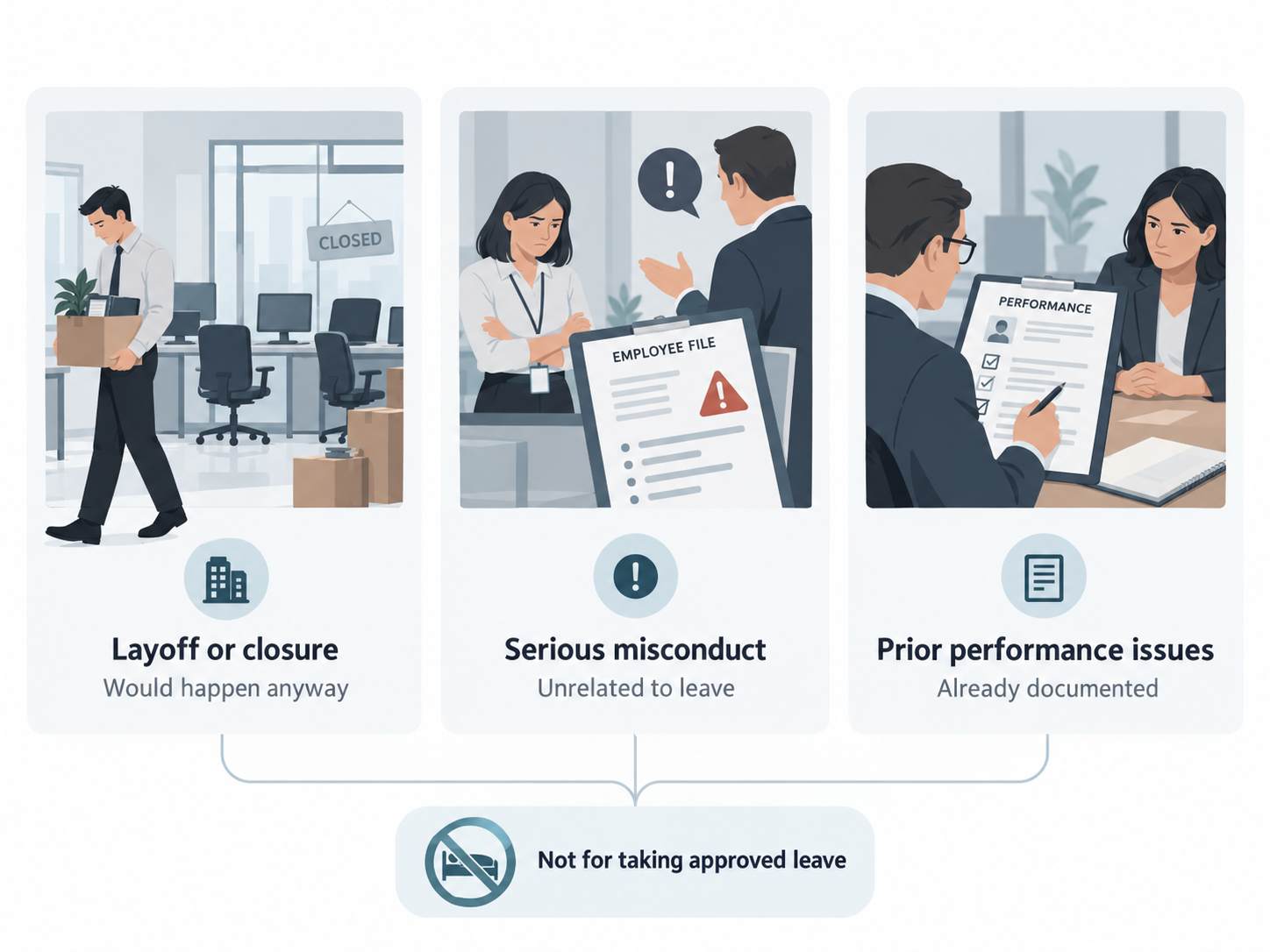
Several situations may allow an employer to terminate employment even though the worker is on approved leave.
Company Layoffs and Business Closures
A company may eliminate positions because of restructuring, reduced revenue or a permanent closure.
An employee on FMLA leave can be included in a legitimate layoff, but the employer must be able to establish that the worker would have been laid off even without taking leave.
Under federal regulation 29 CFR 825.216, an employee taking FMLA leave has no greater right to reinstatement than someone who remained at work.
A sudden decision to eliminate only the position held by an employee on leave deserves closer attention, particularly if the work continues under another job title.
Serious Misconduct Unrelated to Leave
An employer may also terminate an employee for legitimate misconduct that would have resulted in dismissal regardless of their medical absence.
Examples might include documented theft, serious workplace safety violations or falsified business records.
However, the employer cannot simply relabel protected absences as attendance violations. Missing work covered by FMLA generally cannot be used as a disciplinary reason.
Performance Problems Documented Before Leave
Taking medical leave does not erase genuine performance concerns that existed beforehand.
If an employer had already begun a documented disciplinary process, it may be able to continue taking appropriate action.
The critical question is if the employer would have made the same decision without the medical leave.
Workers should preserve earlier performance reviews, written warnings and communications that may help establish the sequence of events.
Can You Be Fired After Your 12 Weeks of FMLA Run Out?
View this post on Instagram
Reaching the end of FMLA leave does not automatically mean an employer can terminate you immediately.
FMLA job restoration rights may end after the protected leave is exhausted. However, the Americans with Disabilities Act (ADA) can provide additional protections for employees with qualifying disabilities.
In certain circumstances, additional unpaid leave may qualify as a reasonable accommodation.
The Equal Employment Opportunity Commission explains that an employer may need to provide additional leave unless it creates an undue hardship or another effective accommodation is available.
For example, an employee recovering from an operation may need three additional weeks before returning. If the condition qualifies under the ADA, the employer may need to consider the request instead of automatically enforcing a termination policy.
However, employers are not required to provide unlimited leave. A request with no foreseeable return date can present a different legal situation.
Employees who need more time should contact human resources before their existing leave ends and provide appropriate medical documentation.
Does the ADA Protect Workers With Long-Term Medical Conditions?
The Americans with Disabilities Act generally applies to employers with at least 15 employees.
It prohibits discrimination against qualified individuals with disabilities and may require reasonable changes to working arrangements.
Possible accommodations include modified schedules, additional breaks, unpaid leave, adjustments to equipment and changes to certain nonessential duties.
Remote work may also be considered when an employee can perform the essential functions of the position outside the workplace.
However, employees are not automatically entitled to work remotely simply because they request it.
The employer must consider the specific role, medical limitations and available accommodations. A position involving equipment or services that must be provided onsite may not be suitable for remote work.
For office-based positions, flexible office layouts and ergonomic workstations may support employees who need suitable changes to their working environment.
The accommodation process should focus on what the employee needs to perform essential job duties without creating an undue hardship for the employer.
What Happens to Health Insurance During Medical Leave?

For many employees, losing medical coverage is almost as frightening as losing their job, particularly when they are receiving ongoing treatment.
Under the FMLA, an employer generally must continue eligible group health coverage on the same terms as if the employee had remained at work.
The employee still needs to pay their usual share of the premiums. If leave is unpaid, the employer may arrange another payment method instead of ordinary payroll deductions.
Coverage outside the United States follows different rules. In Germany, for example, eligible employees can choose between statutory and private health insurance, and changes in salary or employment status can affect their insurance arrangements.
In the United States, losing a job may also mean losing employer-sponsored coverage. Workers may qualify for COBRA continuation coverage or a special enrollment period for another health plan.
According to the Department of Labor COBRA guidance, eligible workers generally have at least 60 days to decide if they want continuation coverage.
COBRA can allow employees to keep the same health plan temporarily, but they may have to pay the full premium and an administrative fee.
Contact the health plan administrator promptly if employment ends during medical treatment. Confirm the coverage termination date and available enrollment deadlines in writing.
Can Your Employer Replace You During Medical Leave?
A company can hire temporary staff or redistribute duties to cover an employee who is absent.
However, eligible workers returning after FMLA leave generally have the right to return to their previous job or an equivalent position with substantially the same pay, benefits and working conditions.
Hiring a replacement does not automatically remove that obligation.
For example, a company may hire someone to cover an employee taking eight weeks of medical leave. When the employee is ready to return, the employer cannot simply refuse reinstatement because the temporary replacement is performing well.
There are exceptions involving legitimate layoffs, inability to perform essential functions and certain other legally recognized circumstances.
If the employer offers a different position, compare its pay, location, schedule, benefits and responsibilities with the original role.
What Should You Do If You Are Fired While on Medical Leave?
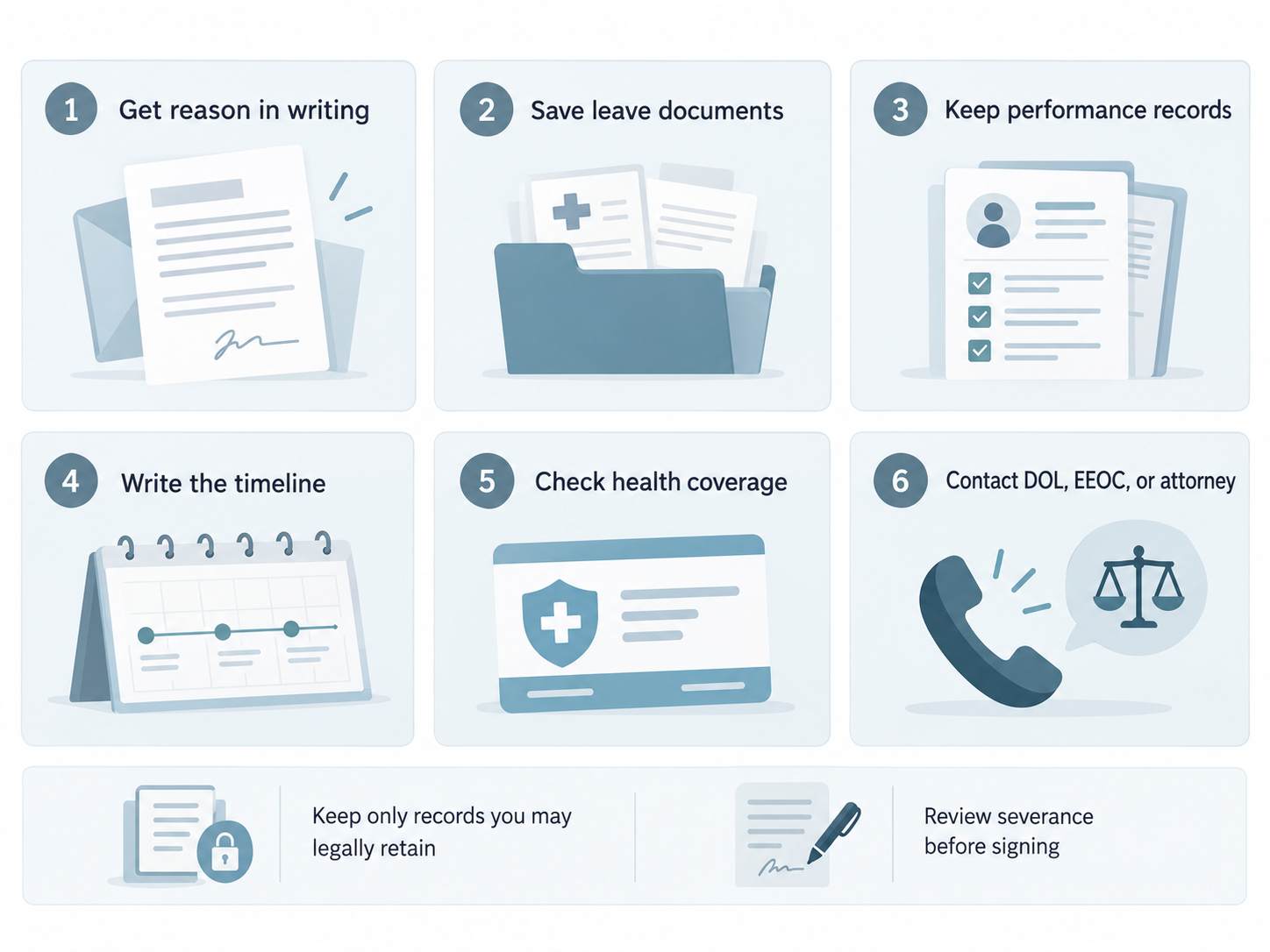
Do not assume that the termination is lawful simply because your employer says the company has a right to dismiss employees.
- Request the termination reason in writing: Ask for the effective date and any documents explaining the decision.
- Save your leave approval: Keep the FMLA paperwork, medical certification requests and correspondence with human resources.
- Preserve performance records: Previous reviews and written evaluations may help establish how the employer treated your work before the absence.
- Record the timeline: Write down when you requested leave, when it was approved and when the termination was announced.
- Check your insurance coverage: Confirm when benefits end and which continuation options are available.
- Contact the appropriate agency or attorney: FMLA complaints can be directed to the Department of Labor, while disability discrimination complaints may fall under the EEOC.
Keep copies of documents you are legally entitled to retain. Do not download confidential company records or private customer information.
If your employer offers a severance agreement or release of claims, consider seeking legal advice before signing. The agreement may affect your ability to pursue certain claims.
How Long Do You Have to File a Complaint?
Legal deadlines depend on the type of claim.
For many federal FMLA violations, a lawsuit generally must be filed within two years. The period may extend to three years for willful violations.
Disability discrimination complaints normally require filing a charge with the EEOC within 180 calendar days, although the deadline may extend to 300 days when an applicable state or local agency enforces a similar law.
Federal employees follow different procedures and generally have much shorter initial counseling deadlines.
State employment laws may also establish separate filing periods.
Because deadlines can begin running before a worker finishes negotiating with an employer, contact the relevant agency or an employment attorney promptly.
Medical Leave Protects Workers, but It Does Not Prevent Every Termination
View this post on Instagram
Employers cannot legally fire eligible employees simply because they request or use protected FMLA leave. Workers with qualifying disabilities may also have additional rights under the ADA.
However, legitimate layoffs, unrelated misconduct and other lawful employment decisions can still affect people who are away from work.
If your job ends during medical leave, ask for the reason in writing, preserve your leave documents and check the deadlines for filing a complaint.
Also confirm what happens to your health coverage. Losing access to medical treatment during recovery can create immediate financial and health concerns, so insurance continuation options deserve attention alongside employment rights.