

Every tough science or math problem seems to wear the same expression. It sits in front of you with that silent confidence, almost like it knows the next two hours might get messy. Anyone who works with big equations, models, or data has been there.
You crack open your notebook, open five browser tabs, and mutter something vague about “figuring it out” while hoping the answer is not hiding behind yet another forgotten identity.
A smoother path exists once you realize that tough problems rarely fall apart because the idea is too advanced. They usually fall apart because something small got overlooked.
A missing definition. A parameter with sloppy units. A shortcut meant for a different form of the equation. Or a model that quietly assumes the thing you are not allowed to assume.
In other words, the real battle is not the problem itself. It is the workflow.
A reliable workflow has layers. One layer refreshes the theory. Another runs the computations and uncovers where the structure bends. A third layer supplies trusted reference data so nothing rests on guesswork. A fourth layer gives you a place to ask questions when your reasoning hits a wall.
Once you stack those layers properly, even the wild problems in physics, chemistry, engineering, or advanced math start behaving like real projects instead of disasters in slow motion.
Here’s a practical map of the most reliable online resources for solving science and math problems at a high level, plus clear ways to combine them.
High-Quality Theory That Holds Up
High-level problems fall apart fast when the theory underneath wobbles. Solid sources keep your groundwork steady and give you the clarity needed to move through tough steps without second-guessing every line.
Below are the resources that reliably anchor that foundation.
MIT OpenCourseWare (OCW)
MIT OpenCourseWare probably shows up in more academic troubleshooting sessions than any single textbook series. The project offers free course material with clear licensing rules.
It is a respected anchor because the content mirrors actual MIT courses rather than watered-down summaries that drift around the internet.
How to Use It When a Problem Is Hitting Back
Why It Belongs in Your Stack
It gives structure. Complex problems go more easily when the theoretical base is not floating in mid-air.
Khan Academy (fast repair of missing pieces)
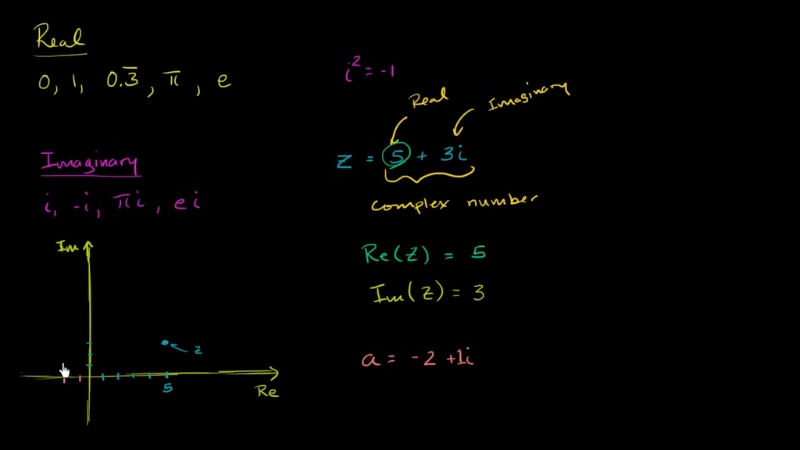
Many problems that look “advanced” collapse as soon as you fix the tiny gap hiding in the prerequisite chain. Khan Academy is useful for patching those gaps with quick, targeted practice.
The interface encourages repetition without punishing you for it, and that helps reinforce the algebra, calculus, or probability moves you keep forgetting.
How to Use It
Why It Matters
Solving advanced problems often demands basic moves executed flawlessly. Quick repair loops prevent small errors from poisoning an entire model.
Coursera and Open edX (guided depth when the gap is wide)
@coursera You don’t need a background in math or coding to start data science. Here’s your 4-step roadmap: Learn Python → Pandas, NumPyPractice Exploratory Data AnalysisBuild a model using Scikit-LearnPublish your project on GitHub Coursera offers beginner-friendly data science programs where you learn by doing — not just watching. Follow @Coursera for more tutorials on Python, data analysis, and AI. Like and comment if you want a full roadmap to your first portfolio project. #DataScience #LearnPython #Coursera #MachineLearning #DataAnalysis ♬ Strawberry – Prod by Rose
Sometimes you need more than a patch. You need a structured block of study. Coursera and Open edX offer long-form courses that come with assignments, lecture sequences, and checkpoints.
They help when you are tackling a problem that touches an entire field you never mastered formally.
How to Use Them for Problem-Solving
Why They Help
They give you depth with guardrails. Hard problems get easier when the required ideas are not scattered across ten unrelated tutorials.
Qui Si Risolve (worked exercises in math and physics)
View this post on Instagram
Qui Si Risolve math learning platform, is a focused problem-solving site built around step-by-step exercises in math and physics, written primarily in Italian.
It is not a replacement for high-authority references, and it does not position itself as one. It works because it offers many fully written solution paths for common university-level obstacles.
Strong Use Cases
A Workflow That Keeps It Honest
- Attempt the problem on your own.
- Compare your approach with the solution on the site.
- Rewrite the full solution in your own words and notation.
- Create a variation of the problem. Change constants or boundary conditions. Solve again.
- Verify any identities through higher-authority references when accuracy matters.
Why it Works
Your brain learns more from comparing two approaches to the same problem than from reading a single answer.
Best Computational Tools
Computational tools carry a lot of weight once problem sets grow into full projects. They reveal structure, expose mistakes, and speed up every part of the workflow.
A few well-chosen platforms can turn heavy symbolic steps, messy numerics, and unclear behavior into something you can probe, test, and refine with far less friction.
Wolfram|Alpha (fast symbolic checks)
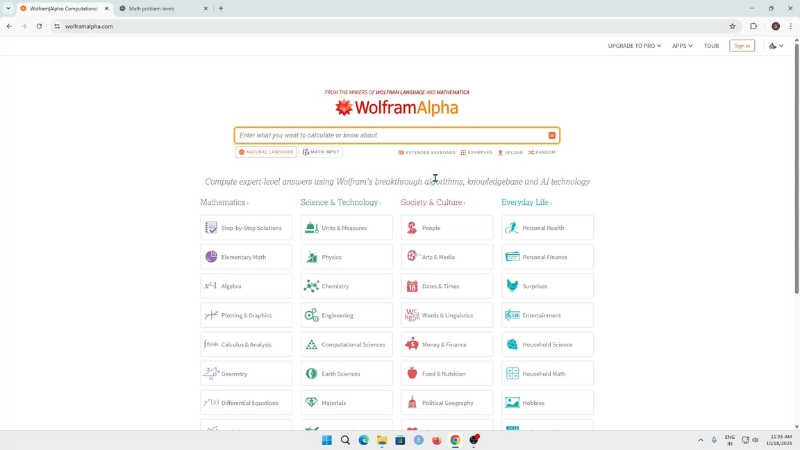
Wolfram|Alpha offers quick symbolic results, simplifications, derivatives, integrals, and equation solving. It is ideal for verifying that your algebraic manipulations do not contain hidden surprises.
Use It For
Common Pitfall
It will answer what you typed, not what you meant. Always restate assumptions and domains.
Desmos and GeoGebra (visual intuition)
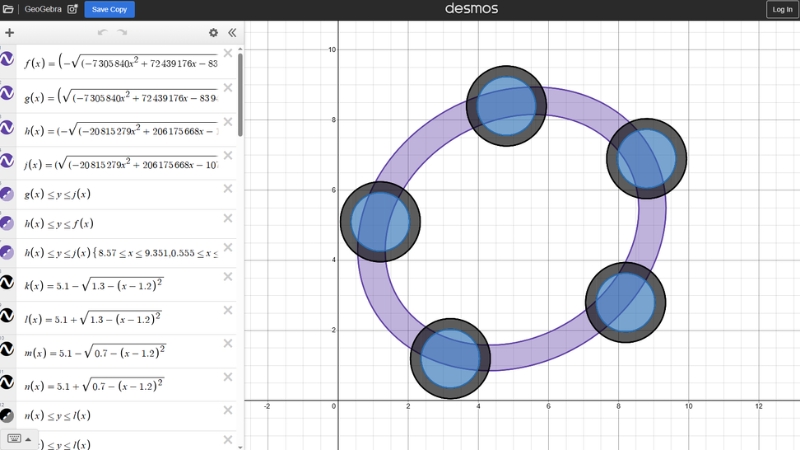
Graphs often reveal structure far faster than algebra. Desmos and GeoGebra give you sliders, axes, dynamic geometry, and quick feedback.
Use Them For
Why Visual Tools Help
Seeing the structure prevents you from forcing a bad symbolic path.
The Python Scientific Stack (NumPy, SciPy, SymPy, Jupyter)
Hello World! 😊
We are the Scientific Python project. This is a community effort to better coordinate and support scientific Python libraries and the people who build them. 🐍🐍@SciPy_team @numpy_team @pandas_dev @scikit_learn @IPythonDev @matplotlib pic.twitter.com/cJGtOzbodM
— Scientific Python (@scientific_py) March 21, 2022
For real scientific work, Python is often the backbone that holds the entire computation together. Each part of the stack covers a different layer of the workflow.
- NumPy: arrays, linear algebra, vectorized computation.
- SciPy: optimization, integration, differential equations, interpolation, eigenvalue problems, and statistics.
- SymPy: symbolic algebra with no external engine.
- Jupyter: reproducible notebooks with live code and narrative text.
Recommended Workflow
Practical Tip
Add “unit tests” to your math. Test small angles, zero cases, symmetry cases, or known special inputs. These quick checks catch half of all silent mistakes.
Best Reference Libraries
The best reference libraries act like guardrails. When formulas get delicate or special functions appear out of nowhere, you want sources that cannot wobble.
High-authority libraries keep your definitions, identities, and assumptions grounded so every step in your solution sits on a solid footing.
NIST Digital Library of Mathematical Functions (DLMF)
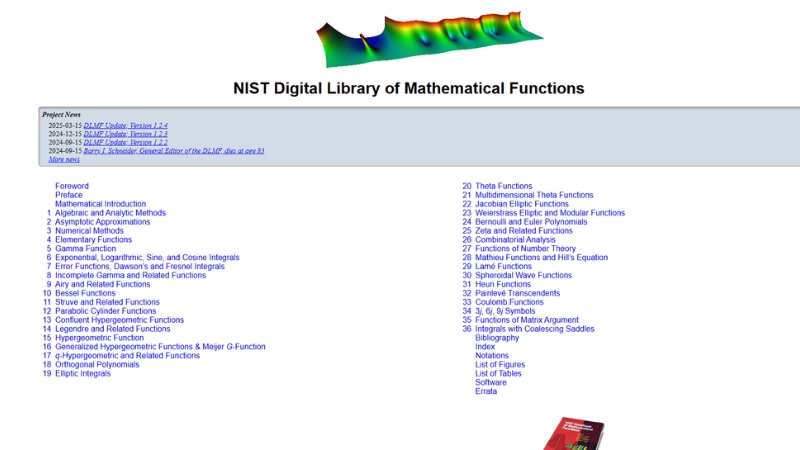
When your problem involves Bessel functions, Gamma functions, error functions, orthogonal polynomials, or anything in that realm, the DLMF is the safest place to check definitions, identities, and branch behaviors.
Use It For
MathWorld (broad math encyclopedia)
MathWorld is ideal when you need orientation. It gives you names, terminology, and quick context so you can search deeper sources correctly.
OEIS (the sequence whisperer)
If you ever generate a sequence that looks suspiciously familiar, OEIS will often tell you the exact family it belongs to. That alone can save hours.
Use It For
NIST DADS and NIST/SEMATECH Statistics Handbook
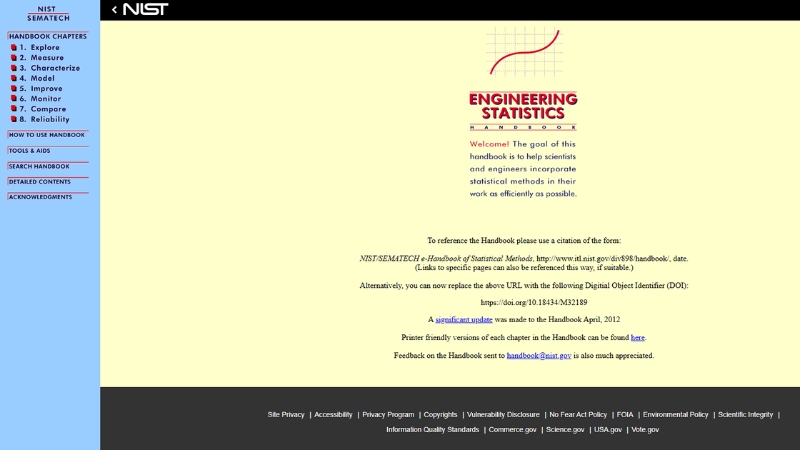
Two extremely practical references for modeling, algorithmic choices, and data analysis.
Use Them For
Best Science Data Resources
Bad data ruins good models. The following sources exist specifically to keep your input values clean.
NIST Chemistry WebBook and PubChem
These two databases cover thermochemical properties, spectra, molecular identity, structure data, and common reference values.
When your chemistry or materials problem depends on accurate constants, these resources make sure you start with the right numbers.
PubMed (biomedical literature search)
Use PubMed when a biology, biophysics, or medical data problem requires grounding in published literature. It is the quickest way to check whether the model you are imagining already has a known structure.
NASA and NOAA Data Portals
Whenever your work touches climate, Earth systems, or environmental data, NASA and NOAA provide vetted observational data. These resources give you real numbers rather than scraped tables floating around textbooks.
Best Community Archives for Getting Unstuck
When progress stalls, the quickest boost often comes from seeing how others approached the same obstacle. Reliable archives of past questions, worked steps, and expert commentary can pull you out of a rut faster than another hour of staring at your notes.
Math Stack Exchange and Physics Stack Exchange
View this post on Instagram
Helpful when a specific algebra step or conceptual leap is blocking your progress.
How to Ask Productively
Why They Work
Community moderation and a large archive of solved questions create a reliable reference base.
Art of Problem Solving (AoPS)
Great for contest-style problems, proofs, combinatorics, and clever constructions. If your work involves deep reasoning rather than numeric grinding, AoPS can give you insight that general forums rarely match.
MAA Putnam Archive
A goldmine for structured, elegant problem solving. Even if you are not doing contest math, Putnam solutions sharpen your sense of clarity.
Two Full Workflows to Show the Stack in Action
Workflow 1: A Differential Equation That Refuses To Behave
Imagine you are working with a second-order ODE and the forcing term is messy. You want behavior, not an elegant closed form.
- Theory refresh: Pull the OCW segment covering ODE methods, such as variation of parameters or Green’s functions.
- Symbolic attempt: Use SymPy to attempt analytic reduction. Confirm derivatives and substitutions step by step.
- Numerical confirmation: Use SciPy’s initial-value solvers. Vary step sizes and tolerances.
- Visualization: Plot the solution using Desmos or a Jupyter plot to see how the behavior shifts with parameters.
- Sanity checks: Try small forcing limits, compare to the homogeneous solution, and check units.
- If stuck: Search Math Stack Exchange for the exact obstacle. Look specifically for solutions with your boundary conditions.
By the time you complete those steps, the “mystery behavior” is usually no longer mysterious. The layered workflow exposes what broke.
Workflow 2: Chemical Equilibrium or Thermochemistry
Suppose you are computing equilibrium constants or reaction energetics.
- Input data: Fetch thermochemical values from NIST WebBook. Cross-check compound identity on PubChem.
- Model building: Write the equations by hand with units in every line. State assumptions, such as ideal-gas approximations.
- Computation: Use NumPy for arrays, SciPy for equations or minimization, and Jupyter to document the pipeline.
- Cross-check: Use Wolfram Alpha for a second independent evaluation of intermediate algebra.
- Sanity route: Test limiting temperature values or simple stoichiometric cases to catch sign errors.
This is the kind of workflow that lets you produce equilibrium values you can trust.
Reliability Rules That Save Hours

Rule 1: Preprints and forums offer leads, not the final word
arXiv materials are not peer-reviewed. Use them for structure, then confirm with journal versions.
Rule 2: Use primary documentation for tools
Official documentation for NumPy, SciPy, SymPy, or Jupyter is usually the only place where fine-print behavior matches reality.
Rule 3: Always verify results with a second method
Symbolic with numeric, numeric with special cases, or a black-box solver with hand-rolled miniature versions.
Rule 4: Write an assumption sheet
Write down units, constants, domains, constraints, and data provenance. Most wrong results come from assuming something you never meant to assume.
Final Thoughts
There is no single best resource for solving hard science and math problems online. What you actually need is a layered toolkit that keeps you from falling into the same traps again.
A mix of theory, computation, reference anchors, and community insight forms a workflow that works across fields. Once that workflow becomes routine, the big, intimidating problems start looking like puzzles that simply need the right angle.
Reliable online material always shows clear sources, precise claims, and no pressure to accept unverified conclusions.
That is the goal after all. Not magic. Not shortcuts. Just a steady method that lets you build solutions with accuracy and confidence.